This race lived up to its name. 3H stands for hazy, hot, and humid. Well, almost; the wildfires in Canada dissipated, so there wasn’t a haze to block the sun. It was 74 degrees at the start with a 73-degree dew point for 97% humidity. By my race finish, the temperature had risen to 85 degrees.
The 18th Dahlgren Heritage Rail Trail 50km was held on Saturday, August 8, 2026. I was the founding race director for this event. In 2016, we added an associated half-marathon race. This edition was the eleventh for the 3H Trail Half-Marathon. For all 18 years, I have either directed or run the 50km or the half-marathon. Only a few other people have been involved for all 18 years; one has completed all eighteen 50 km, and a few from my Race Timing Unlimited staff who now work for Arsenal Events.
 I last managed the 50km in 2020 and sold the events to Arsenal Events. They have organized the two races for six years.
So, why would someone want to run a 50km or half-marathon in the middle of the summer? The conditions make the 50km a challenge more than the distance. We called the half-marathon 3H (hazy, hot, and humid) and did not need to add any infrastructure. Anyone complaining about the heat only needs to look at the name.
Race participation has returned since the COVID shutdown. This year was the most finishers in event history. Even as temperatures reached 95 degrees with a third of the 50km field still on the course, it was not a record low finisher percentage.
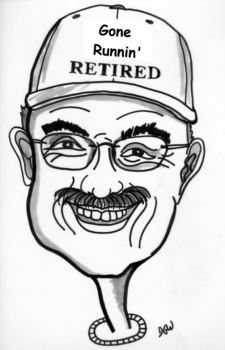
I plan to run the races I founded or managed until I can no longer run. That “can no longer run” clause is getting closer.
For the two years after selling the event, I ran the 50km. Abiding by my doctor’s guidance, I’ve stopped running ultras and stepped down to the half-marathon in 2023. At my current restrictive pace, I could not finish within the 50km race time limit.
The Dahlgren Railroad Heritage Trail is 15.7 miles long and privately owned. It is open to the public via a free permit. Over the years, we have used Caledon State Park and the western trailhead as the race venue.
In 2022, Arsenal moved the start to the trail’s eastern end. This location leverages the numerous hotels and restaurants in the area to accommodate out-of-town participants.
The King George Campus of the University of Mary Washington is conveniently located near the trail. We used their parking lot for staging the race. The Friends of the Dahlgren Trail cut a spur from the staging area to the actual rail trail. Additionally, approximately 200 meters of pavement were used at the start and finish to access the spur. Getting to the 15.5-mile post was about .7 miles from the beginning.
I planned to run 60 paces every 5 minutes and keep my heart rate under 80% (133 bpm) of maximum. This routine continues my recovery from a heart procedure on March 2. I see my cardiologist at the end of the month to get a recommendation of when I can start introducing more stress during exercise.
The trail is marked with a post every 1/2 mile, starting at 0.0 in the west and going to 15.5. I recorded splits on my Timex at every mile post and the turnaround.
Any finish time would be great, preferably faster than the 3:45 I ran at the Deseret News Half-Marathon two weeks ago. After returning from Utah, I still had not registered for this race. I wanted to make sure I was not hurting myself running in hot temperatures. I ended up registering two days before the race and asked the RD if I could start an hour early with the 50km runners. That would give me an extra hour of lower temperatures. Being a late registrant, I did not receive a race shirt.
Since the aid stations were 3.3 miles apart, I wore my double-bottle belt with an initial mix of UCAN Energy in one and UCAN Hydrate in the other. I drank 1/3 of a bottle after each mile, refilling a bottle with water at the 3.3-mile and turnaround aid stations. After the turnaround, I put UCAN Hydrate powder in each bottle. I was able to carry a cell phone in my double bottle belt. I usually don’t run with a cell phone. Out in the woods, you never know. I knew I would be alone for the first 90 minutes until the half-marathon field caught up. After that, I would have others around me until the finish.
The races were advertised as cupless, meaning each runner had to carry a drinking vessel. To help, the race provided a collapsible, reusable cup at packet pickup. These cups, made of a rubber-like material, hold approximately 8 ounces of fluid. I had two left over from the previous years and did not pick one up when I got my bib. Since I had a water bottle, I did not carry a cup.
I left Fredericksburg at 5 am. The start-time weather forecast was 74 degrees with partly cloudy skies and a 73-degree dew point. By my expected finish time, the temperature would rise to 84 degrees. These are typical running conditions for August in Virginia.
When I pulled into the UMW parking lot, I found a spot that would be in the shade most of the morning.
I wore my Nike Pegasus 37 trail shoes, shorts over compression shorts, my white FARC singlet, and a ball cap.
My legs felt OK on the pavement when the gun went off at 7:30 am. I started walking before reaching the spur. I was surprised that my heart rate alarm went off while walking and slowed me down.
The 50km trail sweep was the only person behind me. I assumed there would be a late 50km starter, and there was one. Before reaching the 15.5 mile post, I signaled to the trail sweep and told her I was doing the half, letting her catch the back of the 50km, which was almost to the Owens Road crossing.
I clicked my watch at every milepost. To 15.5, it was 12:30, and then the miles to 10.5 were 18:04, 16:47, 16:59, 16:39, and 16:51. The final section to the turnaround was 14:11, for a first half in 1:51:57. After mile 5, the half-marathon frontrunner flew past me.
I was not having issues seeing the tripping hazards on the trail. The cataracts I had removed over the winter slowed me down last year.
A couple of times, outbound, my heart rate would not slow while walking, and I had to skip the run portion.
My running sections felt better on my return trip. My heart rate dropped in each walking section. I was constantly being passed until reaching the 15-mile post and then stayed with those around me. To help the crossing guards on Owens Road, I hooked onto the runner in front of me. In the sections of the trail without the shaded canopy, I could feel the higher temperatures.
 The initial split back to milepost 10.5 was 15:36, and the next 5 miles were 17:27, 16:16, 18:20, 16:22, and 16:31. From 15.5 to the finish was 11:36. The mile over 18 minutes included a stop in the portapot at the Panorama Aid Station. My second half was 1:52:11, only 14 seconds slower than the first half.
While on course, one 50 km runner passed me as they returned to the finish. So, there was one that ran 31 miles faster than my 13 miles.
My finish time was 3:44:08, 30 minutes slower than last year. I placed 154th overall, 79th among males, and fifth among males 70 and over. I did not DFL. But I have run 10 marathons faster.
Post-race, there were burgers, chips, soda, and ice cream. I had a burger while I distributed finisher’s awards that I had leftover from my RD days to 50km finishers. The previous day, I distributed vintage half-marathon shirts to those runners. I even saw a few on the course. The only thing I have left over from my RD days is 50km shirts. I’ll never give those away or donate them to Goodwill. I may auction off a few each year at the 50km.
Thanks to Arsenal Events for managing this race and the Friends of the Dahlgren Trail for grooming the trail and staffing the aid stations and road crossings.