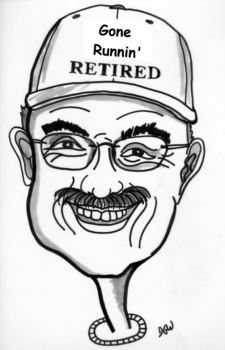
In 1995, I ran the Deseret News Marathon in 3:57:52. Since then, the course was changed to start at the top of East Canyon with an over 3,000-foot drop. With the new Boston Qualifier process, they had to revert to the course I ran in 1995 that started in Parley’s Canyon, went up East Canyon, then back down. This course’s drop is just under the 1500-foot limit. I heard a warning on a podcast that the course was more difficult than in 2025. Yes, it was. This year, I planned a road trip to visit my daughter in Salt Lake City and run the half-marathon. My goal was to keep my heart rate under 133 bpm and beat my marathon time from 1995. The half-marathon course used 12.5 miles of the marathon course and had a 1,643-foot drop in elevation and a 2.3% average grade. The marathon diverted for 3 miles off the half-marathon course. With the low dew point, I felt my goals were achievable. 
I’m sticking with staying under 80% of my max heart rate (133 bpm) for at least six months from my ablation on March 2, 2026. Usually, while walking, the rate is below 100 bpm.
 My plan for today was to run 30 paces every 4 minutes and drink at least 4 ounces of fluid every mile. I set my Garmin alert for 80% or 133 bpm.
The race started at 6 am, a half mile above the top of Emigration Canyon. That was 15 minutes after civil daylight and 15 minutes before sunrise. The marathon started at 5:30 am with a 5 am early start. Both courses merged with the Days of 47 Parade, which started at 9 am, ours after mile 11. Those not reaching the parade route by 9 am were diverted to a parallel course.
I woke up at 2:30 am and checked the weather. The temperature was 77 degrees with a dew point of 50 degrees. By the 6 am race start at the higher elevation, the temperature would be in the high 60s. By the time I finished my race, the temperature would rise into the 80s with sunny skies.
We had to catch a bus to the start between 4:30 and 4:55 am from Rice-Eccles Stadium, home of the 2002 Winter Olympics. A friend of my daughter warned her of parking issues at the stadium, and we left her apartment at 4:10 am for the 10-minute ride. Her friend was not kidding; parking was a cluster. Buses were coming in and out of the one entrance. They were also having difficulty negotiating turns in the parking lot. We had to access the same entrance. There was a small backup when we got to the stadium. Finally, in the lot, there was a multitude of open parking spots.
When we got to where the buses were lined up, the volunteer announced, “These are the half-marathon buses.” We let the first bus fill. Somehow, the volunteer lost count, and it took a while to make sure the bus was full. We were on the right side of the mob when the second bus pulled forward and were among the first couple of people to enter that bus.
When the bus exited the lot at 4:35, they had to hold cars from entering. The backups to enter the lot were extensive—nothing like a little parking stress before a long race.
On the bus, there were some coughs and sneezes, including the driver. After the second one, I put on my N95 mask.
The ride up the canyon was uneventful. Once at the start line, they opened the door and let us out. There were about 20 porta-pots on the side of the road, an adequate number. They dropped us below the units. Knowing I was starting toward the back of the pack, we walked uphill just past the top unit. The bus pulled off, continuing up the hill using Parley’s Canyon for its return trip.
 With 1200 runners, 25 to 30 busloads would be needed to move them to the start area. As more buses came up to the start, runners were offloaded below, above, and in the middle of the porta-pot location. The porta-pot line swelled across the center stripes, and there were no barricades to separate buses from the gathering masses. Fortunately, no one was struck. And, some unnecessary private vehicles were allowed through the start.
About 5:30 am, there were a few announcements that were difficult to discern. The gist was the yellow Penske truck downhill from the start line was the bag drop vehicle. Around 5:45, I took off my overshirt, put sunscreen on my shoulders, and headed down to the truck.
Around 5:55 am, back above the porta pots, we moved into the road. The porta pot line was still rather long. I heard some announcements and waited for the gun. In 1995, a howitzer was used to start the marathon. Today, not even a pop or horn. I probably missed the actual start and started my Timex Ironman when I saw some movement.
I wore shorts over compression shorts, a singlet, a ball cap, and my Saucony Triumph 24 shoes. Wanting to drink every mile, I wore a single-bottle belt with an initial fill of UCAN hydrate. I also carried two packets of UCAN hydrate to add when I refilled my bottle.
We walked downhill, and I started my Garmin and Timex 4-minute countdown timer when we crossed the start line. I ran my first 30 pace interval. In my first walk break, my heart rate went above the 133 bpm limit. I had to walk slower. By my 4-minute alarm, my heart rate was lower but not below 110 as desired. I didn’t miss any run segments, and my heart rate didn’t go over the limit.
The first miles went well in 17:50, 16:32, and 18:14. In the third mile, I stopped at what I thought was a race porta pot near a water stop. Oops, it was a construction unit. The actual porta pot was below the aid station.
Our third mile was slightly past the marathon mile 13. I was expecting a marathoner to pass us before reaching this point. Finally, someone with a marathon number came past us. However, he did not have the expected build and wardrobe. We didn’t know about the 5 am start, so we assumed he was part of a relay team. As more runners passed, a few looked as expected. There were no lead cyclists, which would have helped recognize the male and female race leads.
The next three miles were still in the canyon and were 16:49, 17:03, and 17:13. After mile six, the marathon and half-marathon courses split at the water stop. I stopped at another porta-pot. We continued past the “This is the Place Monument” and Hogle Zoo. The monument did not appear to be aligned with the road as I remembered. Could it have been rotated?
My seventh mile was a 19:01. Before mile 8, the two courses merged when we reached Foothill Drive. The 10km, which started at 6 am, merged with the marathon course when we were on Foothill Drive. The 10 km mile signs were misplaced. They should be 26 feet after the corresponding marathon mile signs. They were at least 200 feet.
To help with the police officers holding traffic, as we approached a major intersection on Foothill, we made sure to hook onto a marathoner and run through the intersection. My eighth and ninth miles were 17:17 and 15:41. Because we were on the north and east sides of the road, we had some shade.
Finally, on 13th East and South Temple, we had more sun, and I was hoping I covered my shoulders enough. My tenth mile was 18:38. We turned left on 7th East and then right on 1st South. At the second intersection, A driver going north on 7th decided to go around the police barricade and turn left on 1st. An officer chased down on foot and stopped the car. I turned to watch to make sure to get out of the way of any shots being fired.
By this point in the course, the 5km, which started at 7 am, race course merged. The 5 km mile signs were misplaced. They should be 13 feet after the corresponding half-marathon mile signs. They were at the same point. My eleventh mile was 16:52.
By this time, it was already past 9 am and the parade had started. We were turned on 3rd East rather than the parade route on 2nd East. We turned right on 7th South, then left on 2nd East for one block of the parade. We made sure to do the appropriate wave.
We left the parade route at 8th South. This road was in full sun with a little uphill. Finally, we turned right on 6th East, then left on 9th South to the finish. There were no mile signs on the secondary route, and even with parallel roads, the diagonals on the turns make this route shorter. The race reported my 12th and 13th miles as 17:02 and 17:02. These were calculated, not actuals. My Garmin had them at 16:46 and 17:21.
Laurel Timing was the race timer and had a small antenna on each of the mile signs to take intermediate splits.
When on 6th, I told Meg we would run to the finish once we reached 9th. So we did. My last .10938 mile was 82 seconds.
 When crossing the finish line, the race announcer stated: “I wonder who talked who into running.” Both of us are accomplished runners. There was no talking into running. I asked Meg if she wanted to run with me. She was a big help, making sure I didn’t have any issues.
You may have noticed the street names I used are how I remember them from my youth.
I was just on the USATF site; none of the four courses are USATF certified, or they were certified within the last month and have not been posted yet. Though a course I measured on July 12, 2026, is posted.
My finish times were 3:45:28 (personal) and 3:46:35 (gun) for 1181 of 1194 overall, 614 of 622 males, and 13 of 13 males 65 to 69. I felt good about finishing, though; I’ve run 10 marathons faster. My heart rate spiked at 150 when I tried to chase down a marathoner wearing a Fredericksburg race shirt.
Post-race, I was a little wobbly in the recovery area and had a few cookies, Coke, and water before walking the few blocks back to Meg’s apartment. On the way, we passed a float that was misdirected into and blocked most of the finish chute.

The results website had a race brief written by AI for each finisher. Mine was:
“Consistent Pacing with a Strong Finish
Vic Culp delivered a steady performance at the 2026 Deseret News Marathon Half Marathon. Starting strong, he completed the first mile at a 16:44 min/mile pace, maintaining consistent splits throughout the race. While initial splits saw his division placement fluctuating between 8th and 13th, he ultimately secured a 13th place finish in the M65-69 division. Notably, his pace stayed around the 17:20 min/mile range for much of the race.
Vic’s perseverance yielded an impressive finish. He demonstrated strength towards the end with a faster last mile at 17:02 min/mile, contributing to an overall pace of 17:12 min/mile. Final race stats included an elapsed time of 3:45:28 over the 13.1-mile course. Comprising 1,377 participants, Vic placed 1180th overall and 617th among males. His determination and ability to pick up the pace in key segments reflect well on his strategic race plan.”
Megan’s was:
“Consistent Pace Improvements}
Megan Culp completed the 2026 Deseret News Half Marathon with a final time of 3:45:28. Notably, her last few splits showed consistent pace improvements, with a notable 16:39 min/mile pace at mile 11, her best split time. She maintained an overall steady pace throughout the race, ending with an average pace of 17:12 min/mile.
Starting strong, Megan hit the first mile with a 16:43 min/mile pace. Her placement adjusted throughout as she navigated through 13.1 miles with strategic pacing. She concluded the race 563rd in her gender category and 51st in the F40-44 division. Suggestions for the future might focus on maintaining stronger mid-race paces to enhance overall placement. Her performance on mile 11 indicates potential to increase speed earlier in the race. Keep building on these improvements for next time.”
We ran the entire race together. They should be the same. Also, AI should have found our past race results and my blog when composing its comments.
This was a true road trip, driving 4475 miles. It took 4 days in each direction, and I stayed with Meg for three nights. I got 46 miles per gallon with an average price of $3.87 per gallon. On my last road trip to Utah in 2022, the average price per gallon was $4.97.