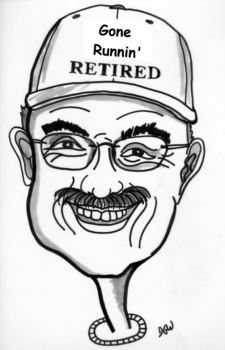
On December 7, 2025, I finished my eleventh Blue Gray Half-Marathon.
I had no confidence in finishing within the time limit, but my result was much better than I expected.
This race was the 25th Fredericksburg Blue & Gray Half-Marathon. Other Civil War Battlefield locations have unassociated Blue & Gray Half-Marathons, most notably, Gettysburg.
I finished the race from 2002 to 2006. In 2007, Race Timing Unlimited and I started timing the race. Until 2019, I was the race director for the event, and I don’t run in races that I supervise.
Since my retirement in 2020, Arsenal Events has been the race manager, and I again started running the race. Yes, we held a race during the COVID panic of 2020.
Over the years, the race has had many start-and-finish venues and courses, ranging from pancake-flat to net-downhill to hilly. In 2017, I moved the start/finish venue to Old Mill Park and designed the current route.
Since my last hospitalization in October, I finished the Marine Corps Marathon using a pattern of running for a minute every six minutes. That race took almost 6 1/2 hours. I’ve been taking 50 mg of Flecainide twice a day since visiting the hospital. With that drug, I have to run to a plan. Today’s plan was to run 3 minutes every 5 minutes and hope for the best.
Since the marathon, my longest runs have been 4 miles, with the longest running segments of about 15 minutes. Impacting my runs, I needed eye surgery and did not want to play with drug modifications until those have been concluded.
Because of my uncertainty, I asked for an early start. (It does pay to be the past race director.) Foremost, if I were having a bad day, I didn’t want to put the current race director in the position of having to decide whether to allow me to run slower than the time limit.
The night before the race, UVA played in the ACC football championship game. I recorded the game and watched it through 9:30 pm. I wanted to watch the rest of the game after the race, hoping not to hear a final score.
I woke up at 5 am. Strangely, my temperature was 99.3. Was that another worry? My blood pressure was normal, and I was in normal sinus rhythm.
 I left home by 6:30. When I crossed the Chatham Bridge, I felt sliding in my tires. I arrived at the park and got a spot close to the start line. I took a final picture and headed to the start line. When I began running, I had a 45-minute head start.
The forecast was mostly cloudy, with start temperatures of 29 degrees rising to 36 by my expected finish time. The dew point was 29 degrees, causing frost on my windows.
With that forecast, I wore tights over compression shorts, a Gore-Tex jacket over a singlet over a long-sleeved shirt, a neck gaiter, double gloves, a knit cap, and my Saucony Triumph 23 shoes. These are the same shoes I used in the marathon. I wore my single bottle belt with an initial mix of UCAN energy. I planned and drank on the walk break after each mile. I refilled at the water stops at 6.4 and 11.8 miles.
Because I had my countdown timer covered, I would not hear the alarms. Instead, I would count 300 paces for run segments and 100 paces during walks. A pace is when my right foot strikes. I would not run up hills or walk down sections.
I ran from the start until I reached the cars coming into the park. For safety, I walked from there up the hill to Caroline Street. I started my run-walk pattern. Before reaching 300 paces, my heart rate alarm indicated I was over 150 bpm. This higher rate only occurred on the first two run segments. Maybe I needed to warm up a bit.
The first 5.25 miles are a loop and a quarter of the Heritage Trail and Canal Path with a side loop on the roads below the college.
My first five mile splits were 13:38, 13:40, 13:26, 12:38, and 12:38. I did not catch the back of the general field. However, I did see the trail sweep as I was approaching the bottom of Fall Hill.
After mile 5.25, the course takes a spur up Fall Hill into Celebrate Virginia South. Fall Hill goes up 233 feet in just under a mile. The average gradient is 4.5%, with a maximum rise of 12.5%. The May Historic Half uses the parallel Hospitalization Hill, which is shorter with a slightly higher average gradient but only a 10.5% max.
In Blue Gray, the significant hill is in the sixth mile, and the Historic Half comes in the eleventh. Though longer and steeper, the sixth-mile hill gives runners time to recover before finishing.
I walked the remainder of the sixth mile with a 15:05 split. The course continues climbing. The first three runners passed me by mile 6, with the lead cyclist trailing. It’s easier to run up Fall Hill than ride it on a bike.
Approaching the I-95 overpass, snow and ice were covering 80% of the trail. The lead runners took the uncovered route to the left. The road to the far right looked clear. I ran on that section to see if it would be passable for those behind me. That side was not runnable. With a three-foot-wide path without ice, it was going to be interesting when runners were going both ways.
The course flattens and turns onto Gordon Shelton Blvd, mostly downhill to the slave memorial turnaround. To be nice to the police, I hooked onto another runner while crossing Carl Silver Parkway. Splits for miles 7 to 9 were 13:25, 12:52, and 12.50.
The nine-mile mark was slightly before the apex of the I-95 overpass. I took the clear path to the right. Outbound runners were struggling with the other side of the path. I continued with the run-walk pattern until reaching Wicklow Drive, where the steep downhill begins. I ran the entire downhill of mile 10 in 10:53.
Once at the bottom, the course completes the last three-quarters of the Heritage Trail and Canal Path loop with a side loop on the roads of Normandy Village. There is an extra down and a challenging little up in the Village. My 11-mile split was 13:16.
For the rest of the race, I was never able to run the entire 300 paces. My focus shifted from counting to goal-setting: “Run to the Jeff Davis Bridge, Washington Avenue, Caroline Street.”
My 12th mile was a 12:29.
Once I got back to Caroline Street, I walked some and ran some. Once I reached the final turn off the Heritage Trail, I was determined to run to the finish. My 13th mile was 13:01, with a 66-second final tenth. Even with a lot of walking, my final five miles were faster than in 2024.
 My finish time was 2:51:03, 6 minutes slower than 2024, placing 263rd overall, 163rd male, and 11th of 12 in the 60 to 69 age group.
I’m happy about breaking 3 hours and keeping a consistent pace, not fading toward the end.
My heart rate averaged 127 beats per minute with a spike to 155 bpm in the first 10 minutes of the run.
This race was my 69th consecutive Coldwell Banker Elite Grand Prix race—one more 5km to finish the 2025 series next Saturday.
I left soon after finishing, heading home to watch the rest of the UVA game, which ended with a promising but disappointing finish.