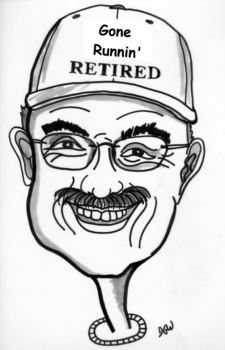
At my June 5 cardiologist appointment, we moved to the second phase of my post-operative recovery. I’m reducing the amount of Flecainide I take daily to elimination. Then, wait a month and wear a heart monitor for seven days. If I have no AFIB occurrences in these three months, we can move to the next phase, eliminating blood thinners.
Last week, I was on half a dosage. This week, it’s on to quarter dosage. After a week of an eighth dose, I need to be off the drug for a month before 168 hours of monitoring. Flecainide is an antiarrhythmic with a few side effects, including slowing my heart rate. At full dose, running for more than a minute at a time is difficult.
After my first ablation, I pushed my comeback, not concerned when my heart rate went above 80%. And I calculated 80% based on my known max heart rate rather than my age-based max heart rate. Until next March, I want to keep my heart rate under 133 bpm, which is based on my age, and will continue to take my beta blockers before, rather than after, running.
At the last two races, I ran 30 paces every five minutes. For the past couple of weeks, my training has been 40-pace runs.
My goals for today’s 5km were to run 40 paces every four minutes and keep my heart rate under 133 bpm.
 In 1986, the Rappahannock Area YMCA began its annual spring River Run 5km. In 1992, they needed to modify their course to eliminate the need to cross William Street twice at Sophia Street. They laid out the course beginning on Caroline Street at the Library and finishing behind the Library on Sophia Street. They reused the route for the initial Turkey Trots, starting in 1993. This course was the first one I measured for USATF certification in 1995. Somebody has used this route for the last 35 years.
My first race on this course was the 1992 River Run; today was my 31st finish. In 2022, we made a slight course adjustment, relocating the start line to Sophia Street to align with the finish line.
The YMCA held the final River Run in 1997, and the Turkey Trot outgrew the course capacity in 2009.
In 2003, the SPCA wanted to hold a fundraiser, so they managed their first 5 km and took advantage of the certified course. The SPCA has been able to utilize this course, which is one of the last 5 km races in the city, entirely on public streets. Working with the city and holding the race at 7 am on a Sunday helps the SPCA maintain the permit. After the 2020 event was canceled due to COVID, this year marked the 23rd edition of the Rescue Run.
In 2004, the Fredericksburg Area Running Club added the race to its Coldwell Banker Elite Grand Prix series, when I first participated in their event.
My alarm went off at 4:30 am. Between monitoring, taking prescriptions, eating, and other things, it takes me almost two hours to get out of the house.
The temperature at the start was 70 degrees, with a dew point of 65 degrees and sunny skies.
I left my house at 6:30 am, warming up on the mile-long journey across the Chatham Bridge to the start line, with 30-second jogs interspersed with walking to get my body used to running.
I wore shorts over compression shorts, my FARC singlet, a ball cap, and my Saucony Triumph 23 shoes.
I joined “Team Cat” again this year. I’m not a dog person and haven’t had a cat for 35 years, but the t-shirts were either cat or dog-specific.
I arrived at the start line with 10 minutes to spare and placed my bag under the Arsenal Events timing table.
Race organizers moved people with dogs and strollers to the back of the pack. They advertised a second wave starting three minutes after the general field. The second wave included people with dogs and those pushing strollers. With the three-minute gap, those catching the back of the general field are running faster and will pass without impacting others’ experiences.
I walked back to where I saw the first dog and asked if that was the front of the second wave.
After the gun went off, I walked to the start line, then ran my first 40-pace interval. I made sure I was out of the way before walking.
Within the first tenth of a mile, the first stroller passed me, then the first dog. Looking at my watch, I saw it had been less than three minutes since the gun went off. There are always people for whom the rules don’t pertain. At about a half mile, a group with dogs started passing me. My watch was over 6 minutes, and those people and dogs went right on past me. So, there had to be a gap in the waves.
My first mile was 14:17, which was faster than my recent race time. I felt comfortable during the run segments.
There were cones on the center stripe the entirety of Caroline Street. They did not need to be there. I ran most of the tangents crossing the center line. Most people did not.
My second mile was 14:13. My legs and breathing felt fine, and a few times, I ran more than 40 paces. I normally don’t drink during a 5km, but I grabbed a cup at around mile 1.7.
Back on Caroline, I did not take the left tangent near Old Mill Park; I stayed to the right of the cones near the Ford Street tangent. I typically run tight tangents, as I measure. Today, I wasn’t as concerned.
In the third mile, there were a few run segments longer than 40 paces, and my heart rate stayed below 130 bpm. Coming up to the three-mile mark, I decided to run to the finish. My third mile was 14:25, and the final 0.10686 miles took 58 seconds. In the last segment, my heart rate maxed at 133 bpm, but it did not trigger my monitor alert. Before I started with heart arrhythmia issues, my typical time from mile 3 to the finish was in the lower 50s. So, today’s pace is a good sign, and it felt unstressed and good.
With a finish time of 43:55, I was 237th overall, 112th among males, and 14th of 18 males in the 60—to—69—year—old age group. Last year, I was 15th out of 16 in my age group. I’m only 45 days from turning 70. I was 10 minutes slower than last year.
My average heart rate during the run was 121 bpm with a maximum of 133 bpm. My pace peaked at 8:33 minutes per mile.
Looking back at my 31 runs on this course, my fastest time was 20:28 at the 1995 River Run. That year, I finished 69th overall and 65th male. In the 35 to 39-year-old age group, I was 16th. If I had put that time into today’s race, I would have been 9th overall.
Another note from that 1995 race: 272 finishers were under 30 minutes, and the remaining 29 were in before 35 minutes. With today’s time, I would have been DFL by 9 minutes.
Keep plugging away. I now have a 76-race active finish streak in the Coldwell Banker Elite Grand Prix. That is the fourth-longest streak. I already have the third longest at 124. It will take four years to get there.
Up next is the Fallen Heroes 5 Mile on July 4. Starting tomorrow, I’m doing 50-pace run segments, while still keeping my heart rate under 133 bpm.